Side quests at GitHub Universe: who owns AI proof now?
Last month at LDX3 New York, the question on every leader’s mind was whether AI had moved the business. (Read our recap here.) Last week at GitHub Universe, I heard the same question, this time from developer experience (DevEx) teams and AI adoption leads.
Julia (Jules) Burmeister, our head of product, and I went without a booth or a speaking slot. Call it guerrilla marketing: we brought stickers, a stack of game cards, and a plan to spend most of our time in the hallways. It was a lot of fun to cosplay as marketers.

A developer crowd, asking leadership questions
GitHub Universe skews toward developers, DevSecOps, and DevEx. Most of the vendors and talks, unsurprisingly, focused on individual developer workflows.
So we expected fewer conversations about measurement. We got plenty anyway. In Jules’ hallway chats, the same issue kept coming up: with this much code moving this fast, how do you even know what’s happening anymore? Some of the orgs Jules talked to aren’t tracking any metrics yet. Others want to build their own dashboards but aren’t sure which framework still holds up at the pace AI is changing the software development lifecycle (SDLC). Many described low visibility and few standardized processes.
And the pace isn’t slowing. GitHub’s Octoverse report puts a number on it: by September, more than 40% of pull requests (PRs) on GitHub started with an AI agent’s first draft, up from 17% in March.
AI adoption has its own team now
I kept meeting people with “AI adoption” or “AI enablement” in their titles.
Some sit on DevEx teams that now own AI rollout and measurement. Others belong to new groups built for this purpose, sometimes led by a recent hire brought in to run it, and their mandate is big: get AI working across the engineering org, then show what it’s changing.
The first part is fairly easy. Most developers are happy to try out the newest models and experiment with different tools. The second part is a lot harder. Several of them told me they’re still looking for a way to see the impact of AI on engineering.
The build-it-yourself pressure is real
I talked with an engineering manager on a DevEx team at a large company, where they’d recently reviewed their engineering intelligence options. Cost was a big factor, so leadership decided to build their own in-house tool.
When he told me this, he made a face. I asked why. He said the problem with building it is that they have to own it.
That wasn’t an uncommon response. Plenty of teams feel pressure to DIY solutions. But nobody I talked to wanted to maintain a homegrown platform long-term. Not least because when your codebase changes at AI speed, whatever you build to watch it has to keep up too.
Planning is getting collaborative too
GitHub’s closing keynote included a look at Chopin, a GitHub Next research prototype where teammates and agents write the same plan together. Threads can branch into research, debate, or prototypes of different design directions, and the plan keeps a record of who decided what, and when.
I really liked the Chopin demo because we’ve been doing a rougher version of this in shared AI docs. Claude and Zoom both have their own takes on collaborative, AI-assisted docs now, building on the Confluence and Google Docs approach.
When code ships faster, the decisions about what to build have to keep pace. They also need to live somewhere your team can find them later, when the next engineer (or agent) picks up the work. That record makes it easier to prove what AI is doing. Line up what the team decided to build with what actually changed in the code, and you can see whether AI is moving the work that matters.
Hallway marketing, with stickers
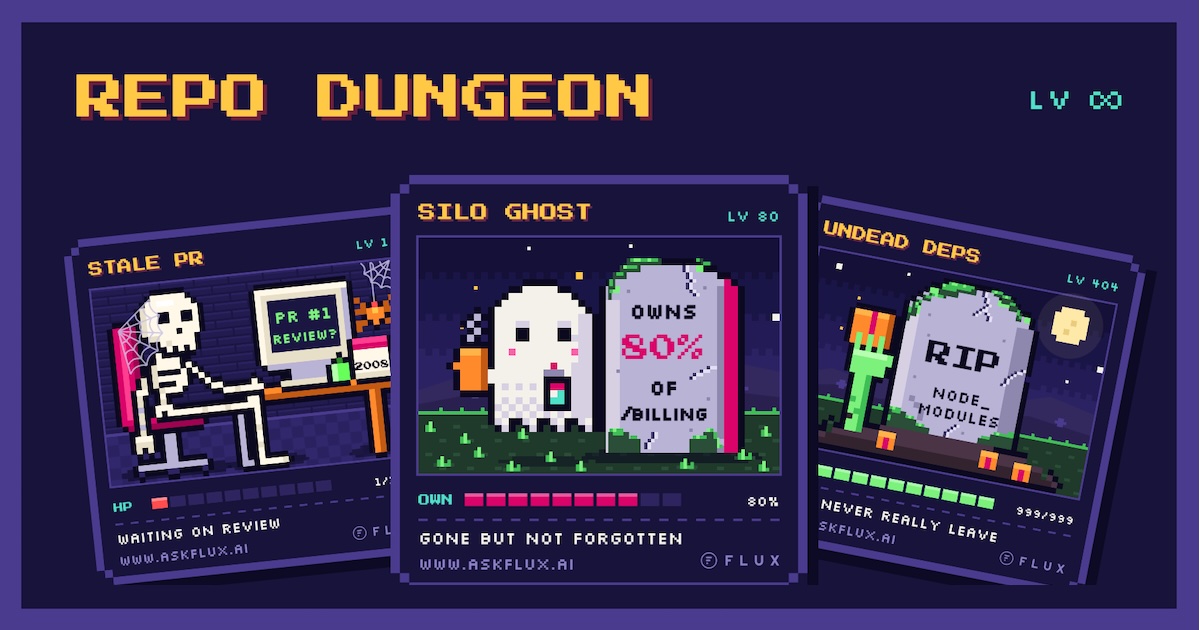
Plenty of exhibitors ran games this year, from arcade machines to games printed on cards. Most of them stayed on the expo floor. We brought ours in our pockets: Repo Dungeon, a free browser game about surviving a messy codebase that you can play on your phone or laptop.
Jules designed our stickers herself (you can see them in this post’s header) and put them on just about every surface she could find. People loved them, and they went fast. The game cards went slower (they were big, pockets are small, and you can’t put them on your laptop).
If you stopped us in a hallway to ask about a sticker, thanks. And if a Repo Dungeon card ended up at the bottom of your conference bag, dig it out. Or skip the card and play it now. It’s a retro dungeon crawler in the spirit of the games some of us grew up on.
So who owns AI proof now?
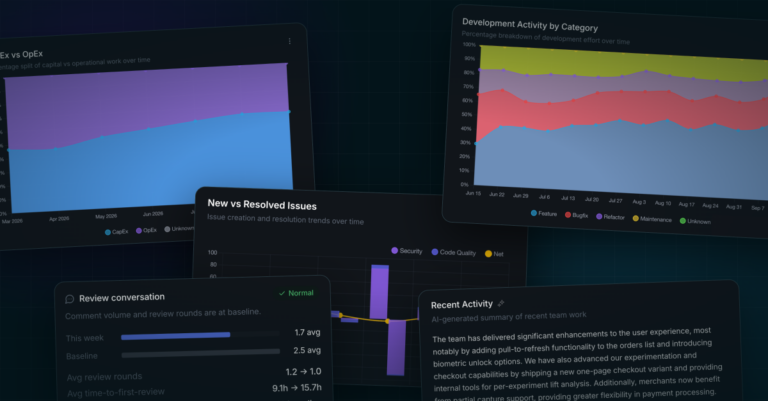
From what we saw at Universe, it’s increasingly DevEx teams and dedicated AI adoption leads, alongside engineering leadership. If you’re the one on the hook, the evidence already exists in your code, commits, and PRs.
Finished your side quest? Request a demo when you’re ready for the main one.