
Why code-first engineering intelligence matters
AI accelerated your team’s output. It didn’t improve your engineering visibility. A code-first approach gives you ground-truth intelligence directly from the codebase, not from tickets or filtered reporting.
More code. Less clarity. Higher expectations.
Get the report: AI Code Generation Reality Check
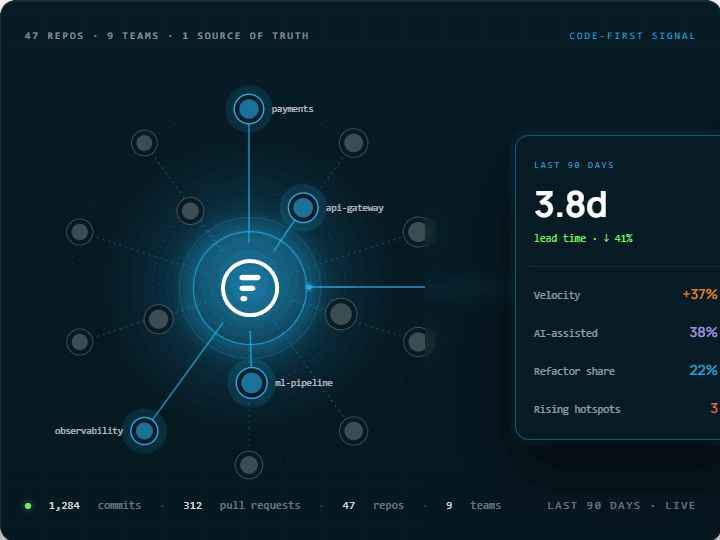
AI increased output. It also broke your visibility.
AI copilots, code generation, and agentic workflows have increased the speed, volume, and complexity of code changes. The systems you use to track engineering progress were built for a human-speed world.
The result: more code, less clarity about what’s actually changing, where effort is going, and where risk is accumulating.
45%
have AI-generated code in production
35%
are coding with AI but not yet shipping it
80.5%
changed development or release produces because of AI-generated code
Leadership still needs to provide answers
You’re still accountable for delivery, quality, tradeoffs, and risk. Poor visibility based on tickets and manual updates has real costs. Leaders risk lost credibility, strategic drift, burnout, operational incidents, and career damage when they can’t course-correct in time.
Question
01
How much of our work is really feature delivery?
See the real split between feature delivery, maintenance, refactoring, and rework. Derived directly from commits and PRs.
Question
02
Is AI improving momentum, or just increasing output and review burden?
Surface AI-attributed code volume, PR review time, and merge rates. See whether acceleration is real.
Question
03
What work is consuming time but not showing up in Jira?
Uncover shadow work, maintenance, refactoring, and hidden coordination from code activity, not tickets.
Question
04
How do I explain progress, tradeoffs, and risk to executives or the board?
Generate board-ready insights from the codebase: actual work mix, momentum trajectory, and evidence-based risk analysis.
Why ticket-based visibility is not enough
Ticketing systems still matter. But intent and status aren’t enough to make decisions about work, capacity, and business impact.
Ticket-based management

Captures intent and status
Depends on human upkeep
Notoriously inconsistent across teams/groups
Hides shadow work
Often lags reality
Code-first engineering intelligence

Captures actual work and code change
Derived directly from code activity
Shows actual work mix, momentum, risk
Surfaces maintenance, refactoring, and hidden effort
Reflects changes as they happen
What code-first engineering intelligence actually means
Code-first does not just look at code. It uses the codebase as the foundation for leadership-level intelligence.

Velocity and momentum
See real progress, not reported activity. Understand delivery flow, PR size, churn, and slowdowns before they show up in retrospectives or escalations.

Strategic impact
Separate feature delivery from maintenance, refactoring, and rework. Surface the shadow work that consumes time but never appears in planning systems.

Team dynamics and context
Understand collaboration patterns, review flow, and mentorship signals. Spot force multipliers, friction points, and knowledge concentration.

Code quality and risk
Identify hotspots, architectural drift, dependencies, and accumulating technical debt before they turn into outages, delivery slips, or expensive fire drills.
From intuition to evidence:
what this looks like in practice
225
GitHub repositories
Q4
Board-deck centerpiece
1
Engineering offsite slide
“Flux produced the single most compelling graph in our Q4 board report. It showed how we shifted from maintenance to meaningful feature delivery.”
— Mike Garon, VP of Engineering at Cobalt
See what’s really happening in your codebase
See real progress, work mix, technical debt, team dynamics, and risk. Directly from your codebase. No process overhead required.
The Details
Frequently asked questions
Q.01
What is code-first engineering intelligence?
Code-first engineering intelligence derives insight directly from how code is changing: commits, PRs, and contribution patterns. Not from tickets, manual reporting, or proxy metrics.
Q.02
How is Flux different from a project management tool?
Flux does not replace your project management tool. It gives you a layer of visibility that ticket systems cannot provide: what is actually happening in the codebase, not what was planned or reported.
Q.03
Does Flux require changes to our engineering workflow?
No. Connect your GitHub Cloud organization and Flux starts analyzing. No tagging, no new workflows, no process overhead for your team.
Q.04
How does Flux handle AI-generated code?
Flux attributes and analyzes AI-generated code alongside human-written code, helping you understand how AI is affecting velocity, quality, review burden, and technical risk.
Q.05
Who at our company should use Flux?
Flux is built for engineering leaders: CTOs, VPs of Engineering, and Engineering Managers who need ground-truth visibility into progress, risk, and team dynamics.
Q.06
How long does it take to get value from Flux?
Most teams see meaningful insights within their first session. There is no onboarding tax, no required data entry, and no ramp-up period.