




Years from now, when we look back at 2025, it will be remembered as the year software engineering changed forever. Coding assistant adoption set the stage in 2024. But by the end of 2025, AI has infiltrated every part of the development process. With that, expectations of Engineering—and the level of scrutiny on this function by boards and leadership—reached an all-time high. At Flux, we experienced this as engagement exploded with Engineering leaders looking for a way to drive AI transformation while maintaining quality and proving ROI. Through this course of this customer discovery we learned a ton, shipped a lot, closed more business than ever, and had a bunch of fun.
Quality + Metrics = Urgency
Our lean team makes lots of commits daily and has delivered a ton this year. We’ve gotten even better at multi-dimensional code quality assessment - spanning quality, complexity, security, etc. And like all things Flux, we do it automatically (no burden on your team), and based on the code (source of truth, not a ticket). But adding metrics to the mix this year changed everything. More top of the funnel and faster deal progression. Customers progressed with intent because this combination allowed them to lean into AI transformation knowing: 1) they have guardrails and 2) can easily generate metrics to prove ROI.
Feedback → Product in Days
The magic wasn’t just what we did, but how we did it. Here’s a common scenario: get great insight for how a capability should be implemented on Wednesday, Gen AI an interactive mock to share on Friday for feedback, then leverage feedback to deliver the feature (often with more generative work) a few days later. “It’s done and we turned on the feature flag in your tenant.” This never gets old.
Outcomes in Customers’ Words
I want to make informed decisions without having to read through all the code and understand it. Where should I invest effort to have maximum impact? Where can I mitigate the greatest risk? Where could I apply the resources I have to most improve the code base?
Co-Founder and CTO, high-growth B2B startup
I now understand this codebase better than at my last gig. I was there for 10 years.
VP Engineering, high-growth software company
Work on new features is capitalizable, other stuff isn’t. Measuring this is really important, but really hard. And it’s real money, not a theoretical productivity boost. Our CFO will happily approve the purchase of Flux on this basis alone.
VP Developer Experience, media company
AI Applied to Code Is Fascinating
Having done several startups before, I can say that building in the age of AI is really fun. The pace of delivery and customer discovery that AI enables is thrilling. Even better, however, is applying AI to coding as the tooling (like LLMs) is so well suited to the context (structured code). That doesn’t mean that we didn’t make a ton of mistakes - we definitely did. Or, that it was easy - figuring out product market fit is still excruciating. But multiple things we tried this year did work. And the results were kind of breathtaking… even profound. For example, our automatically-generated descriptions of what the code actually does.
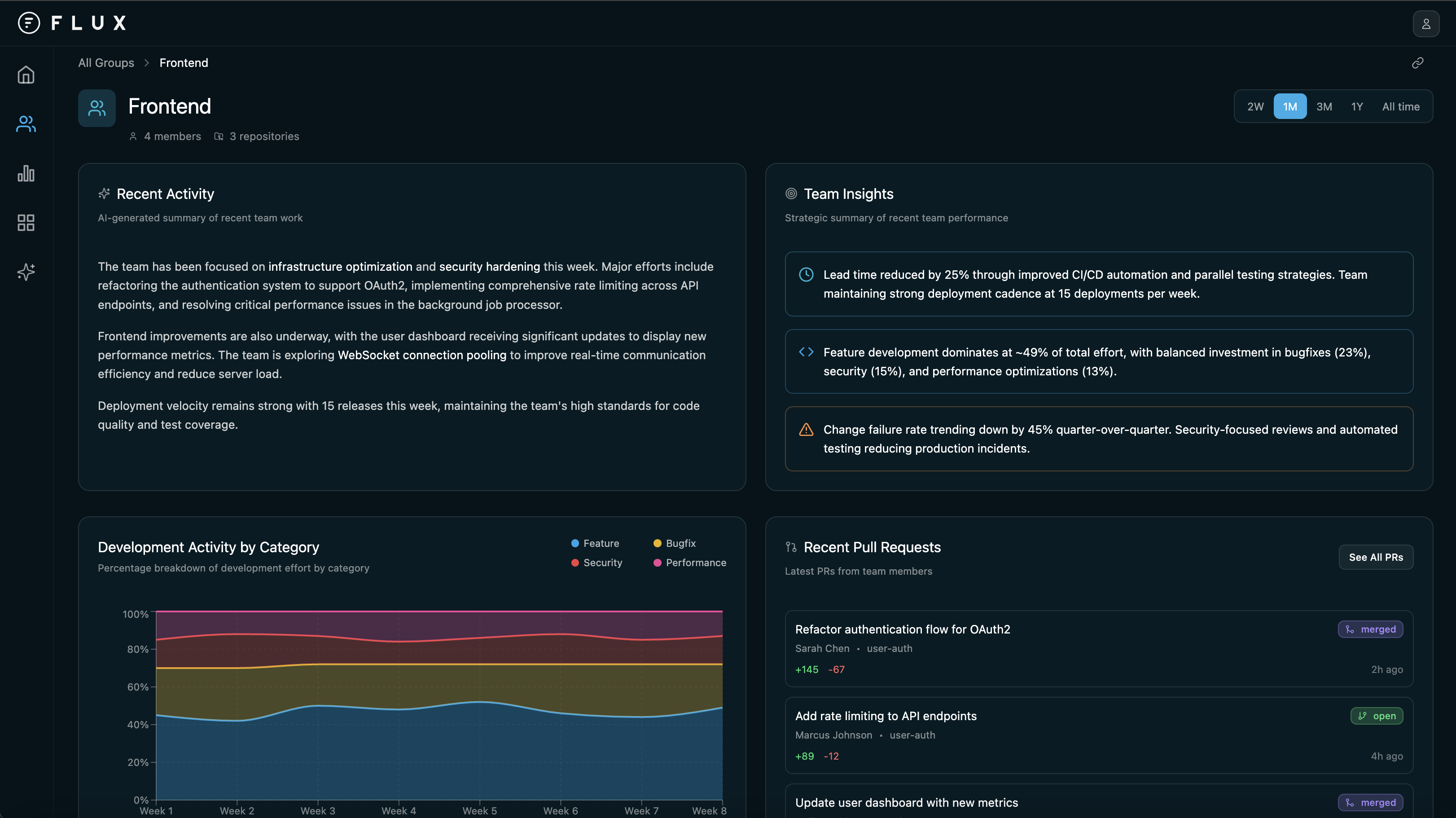
What were Team X’s PRs in the last two weeks? No problem. The frontend teams work this month? Easy. My team’s commits last week when I was off-site? Done.
Best of All Is Doing It With This Team
None of this would be possible, however, without the team. From clever backend work to ensure scalability, to crafty UX that takes something hard and makes it easy, to a sexy and responsive UI you want more of - the team delivered with creativity, quality, and aplomb. But this goes beyond Flux staff, to our partners, vendors, and consultants. And of course, our investors who bought into the vision at the beginning and have been our staunchest supporters.
The World’s in Flux - You Should Be, Too!
If this sounds interesting to you, get in Flux! We have a sandbox environment here. Or, you can just ping me directly at ted@askflux.ai.
Ted Julian is the CEO and Co-Founder of Flux, as well as a well-known industry trailblazer, product leader, and investor with over two decades of experience. A market-maker, Ted launched his four previous startups to leadership in categories he defined, resulting in game-changing products that greatly improved technical users' day-to-day processes.


